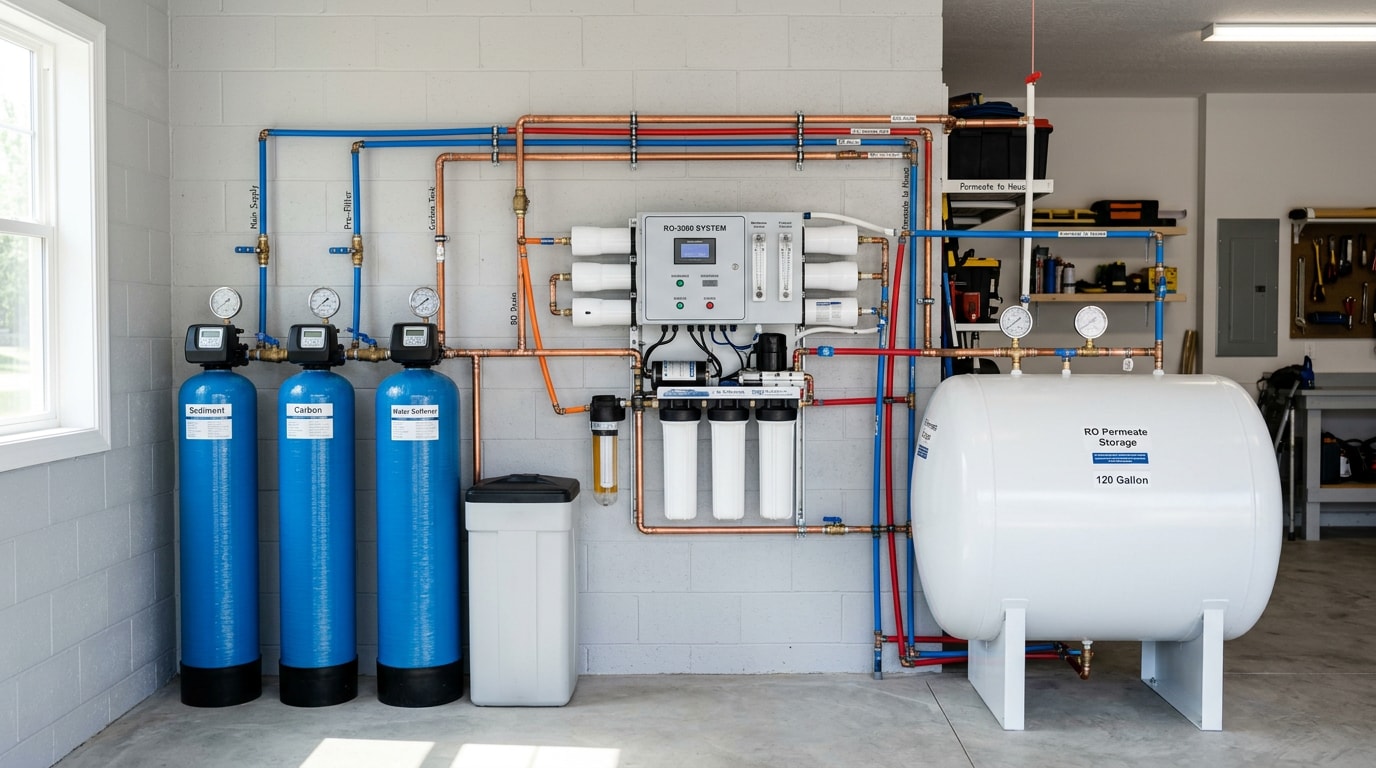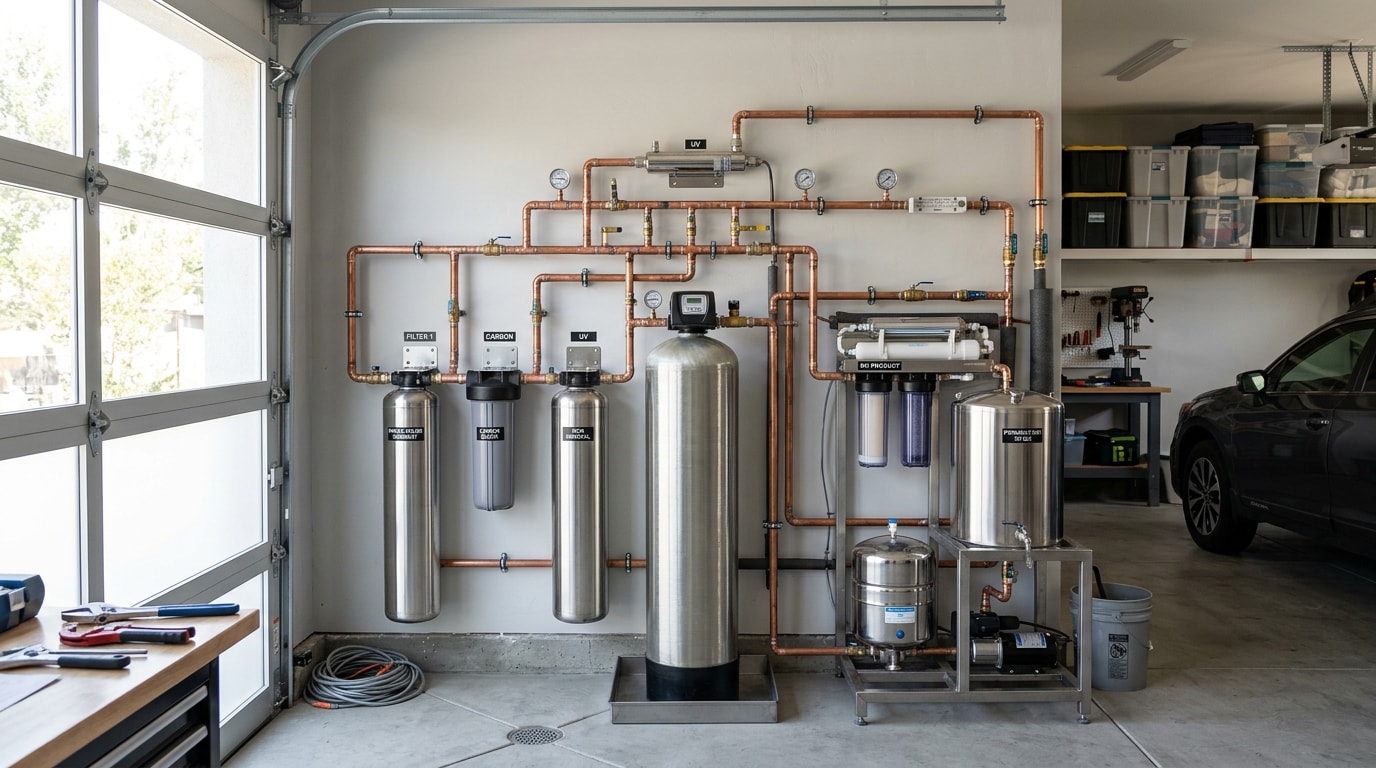
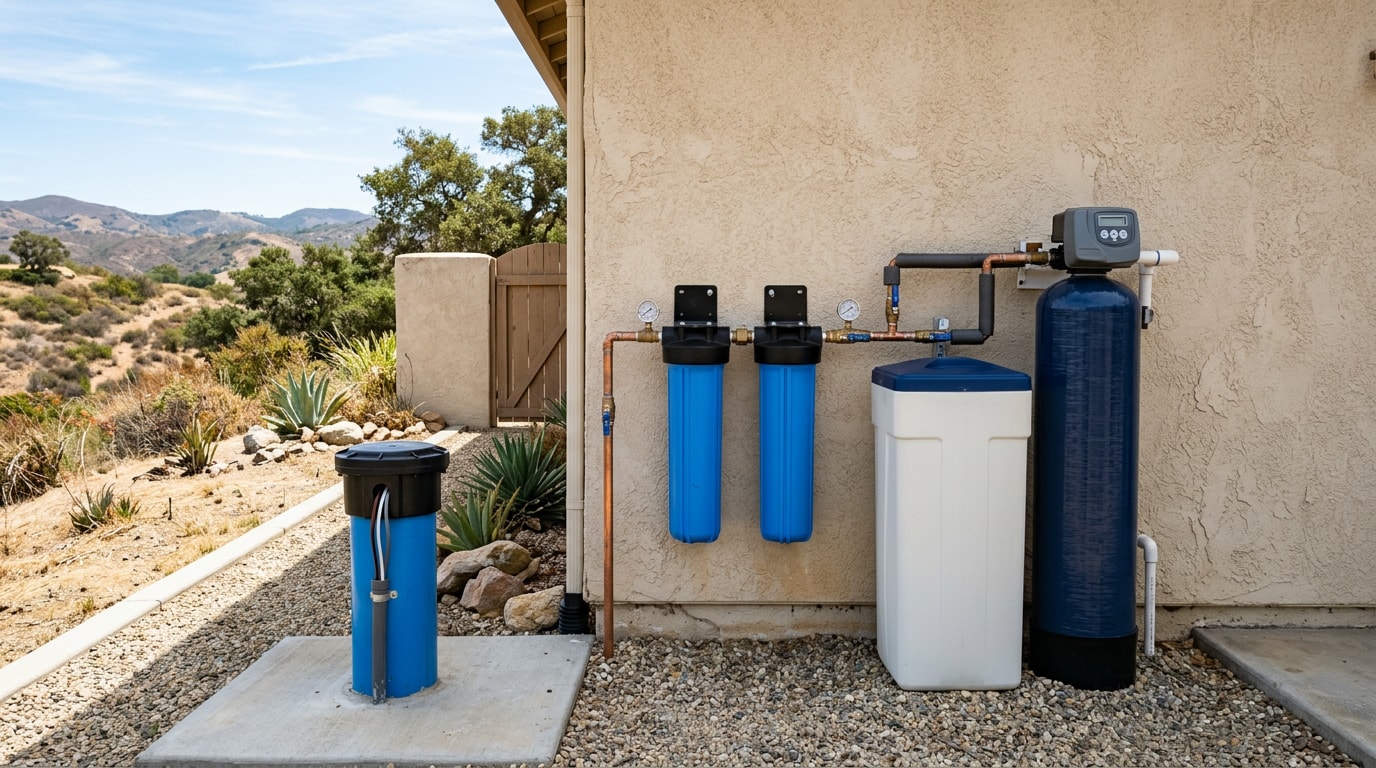
Well water filtration in Los Angeles County, CA is the only thing standing between raw groundwater and your kitchen tap if your home sits on a private well. Across Antelope Valley, the Santa Clarita foothills, Acton, Agua Dulce, and the rural canyons of the San Gabriel and Santa Monica Mountains, no municipal utility treats, tests, or monitors what comes out of the ground. This guide covers the contaminants LA County well owners actually see on lab reports, how multi-stage systems are built around those results, and what a well water analysis typically turns up first.
Common Well Water Quality Issues in Los Angeles County
Groundwater quality shifts within a few miles across LA County's major basins. No two wells need an identical treatment plan.
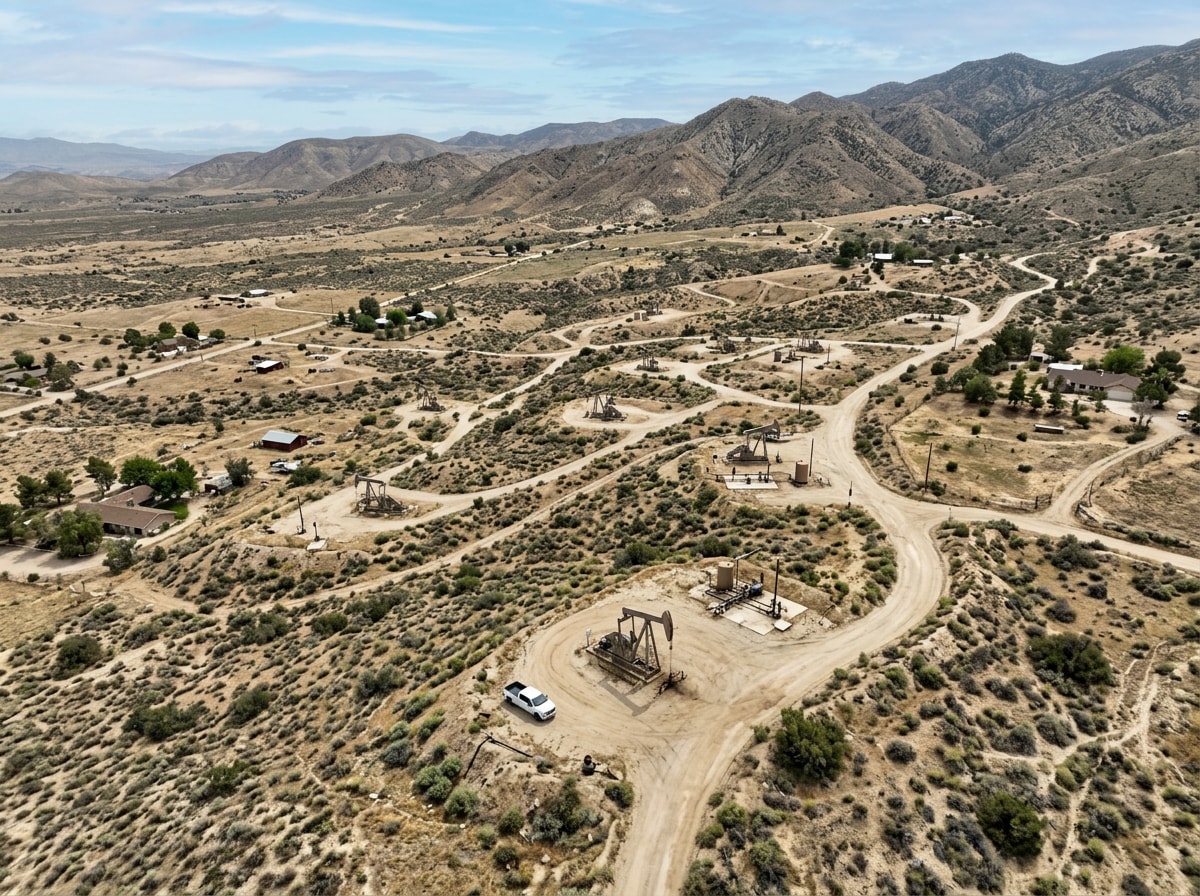
Wells in the Antelope Valley basin often show elevated arsenic and hardness tied to the area's alluvial geology. Wells drawing from the San Fernando Valley basin tend to flag more sediment and iron instead. San Gabriel foothill wells frequently combine hardness with an occasional sulfur odor.
Across the county, the issues we see most often include:
- Sediment and cloudy water
- Hard water and mineral scale buildup
- Iron and orange or brown staining
- Sulfur odor (rotten-egg smell)
- Arsenic
- Nitrates
- Bacteria
- Volatile organic compounds (VOCs)
- pH imbalance
A federal groundwater study of the Antelope Valley basin is worth knowing about before you assume your well is fine. Arsenic was present at high concentrations in 28% of the primary aquifers sampled, a larger share than any other desert groundwater study area evaluated. That single data point is why guessing based on a neighbor's system doesn't work. Understanding what your well actually contains starts with a lab test.
Private well water isn't regulated the way city water is. Private well owners are responsible for delivering safe drinking water to their households , which is why the EPA's private wells program exists mainly to educate owners rather than enforce a standard.
How a Well Water Filtration System Is Designed
Private wells rarely have just one problem. A system gets built as a sequence of stages matched to lab results, installed at the home's point of entry, rather than sold as a single generic box.
In the wells we've tested across Antelope Valley and Agua Dulce, arsenic rarely shows up alone. It's almost always paired with hardness or iron, which changes the order the equipment goes in.
| Contaminant | Common Symptom | Typical Treatment Stage |
|---|---|---|
| Sediment | Cloudy water, gritty taste | Sediment pre-filter |
| Iron | Orange/brown staining | Oxidation filter |
| Hardness | Scale on fixtures, soap scum | Water softener |
| Sulfur odor | Rotten-egg smell | Oxidation or carbon filter |
| Arsenic | No taste or smell (lab test only) | Adsorptive media or RO |
| Chlorine taste/odor at the tap | Flat or chemical taste | Carbon polishing filter |
See how whole-house filtration stages typically layer together below.
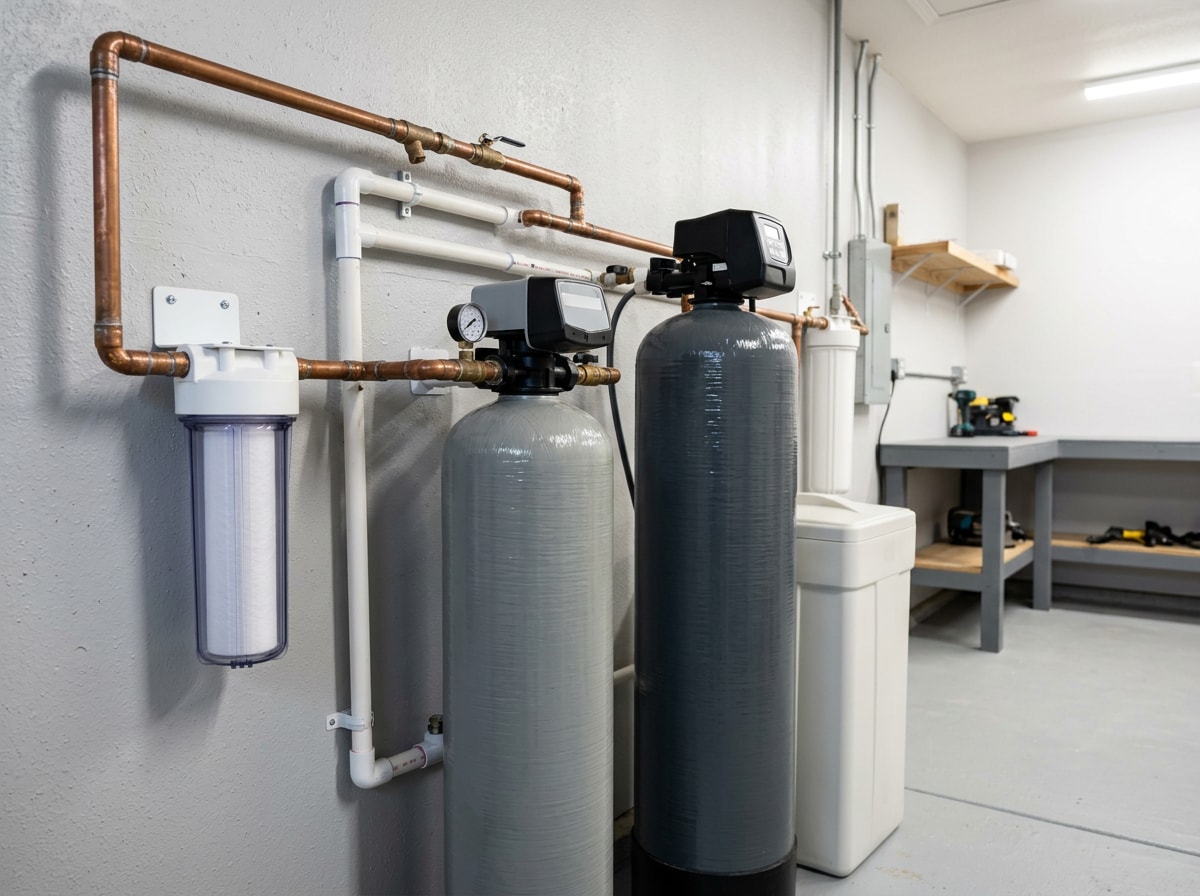
Iron Removal From Well Water
When testing shows elevated iron, an oxidation stage gets added to stop staining on fixtures and laundry. This stage converts dissolved iron into particles that can be physically filtered out before water reaches the rest of the home's plumbing.
Hard Well Water Treatment
A water softening stage only gets added when test results confirm hardness. Left untreated, hardness causes scale buildup in pipes, water heaters, and appliances. When minerals are already low, this stage gets skipped to avoid paying for equipment you don't need.
Final Filtration
After the primary stages handle sediment, iron, or hardness, a polishing filter usually finishes the job. This stage refines taste and clarity, rounding out the sequence before water reaches household taps. A properly designed well water treatment system accounts for every stage your test results call for, not just the obvious one.
Reverse Osmosis for Well Water
Untreated well water carrying hardness, iron, or sediment can clog a reverse osmosis membrane fast. Pretreatment matters more for wells than it does for city water. A sediment and iron stage typically runs ahead of the RO unit to protect it.
Once pretreated, reverse osmosis delivers high-purity drinking water at the kitchen tap. It's often paired with whole-home polishing, but that pairing depends entirely on what the water test shows, not on a default package.
Arsenic Removal From Well Water
Arsenic occurs naturally in parts of LA County due to local rock and soil chemistry, particularly in Antelope Valley groundwater. Because arsenic rarely shows up alone, removal usually gets integrated with other stages like filtration, softening, or RO rather than installed as a standalone fix.
On January 22, 2001, EPA adopted a new standard for arsenic in drinking water of 0.01 mg/l or 10 parts per billion (ppb), replacing the old standard of 50 ppb , according to EPA's arsenic rule history. That number is a useful benchmark when reviewing a lab report, though private wells aren't legally required to meet it. If you're also dealing with other emerging contaminants, our PFAS filtration guide for Los Angeles County covers a different but increasingly common concern in local groundwater.
What Does Well Water Filtration Cost in Los Angeles County?
Cost depends entirely on which stages a well actually needs. A home that only needs sediment filtration and a softener costs far less than one that also needs arsenic media or whole-house RO. Guessing at a number before testing almost always leads to buying the wrong system, either underbuilt or overbuilt.
The only accurate way to price a system is to test first, then quote against the real results. Request a free estimate and we'll walk the property, review the test, and price only the stages the water actually calls for.
How Often Should You Test Private Well Water in LA County?
Testing isn't a one-time event. Test your well water at least once every year for total coliform bacteria, nitrates, total dissolved solids, and pH level , per CDC guidelines for testing well water. Government officials do not regulate, treat, or monitor tap water from private wells , so that annual check is entirely on the homeowner.
Beyond the yearly basics, re-test anytime the water changes in taste, smell, or color, after well repairs, or if arsenic or another contaminant has shown up before. Our contaminant detection testing covers the local concerns most LA County wells actually run into.
Well Water Filtration Solutions Throughout Los Angeles County
From Antelope Valley to Agua Dulce and the rural canyon communities, thousands of LA County homes depend on private wells. Solutions get matched to each property's test results rather than sold as a one-size package, and coverage extends across our Los Angeles County service area.
If you're ready to find out exactly what's in your water, visit Pure Water Filtration to see our full range of treatment and testing services, or go straight to contact us for a free estimate.
FAQ
Do I need more than one filter for well water?
Often yes. Private well water commonly has multiple issues at once, so a combined approach addressing sediment, hardness, and contaminant-specific stages is typical.
Can a whole-house filter remove iron?
Yes, when the system includes an oxidation stage. A standard whole-house filter alone may not fully remove iron without this dedicated step.
Do I need a water softener with well water?
It depends on hardness levels. A softener is appropriate only when test results confirm elevated hardness; otherwise it's an unnecessary add-on.
Can you treat arsenic in well water?
Yes. Arsenic treatment depends on water chemistry and test results, and it's often combined with other filtration or softening stages rather than handled alone.
How is well water different from city water?
Well water receives no municipal pre-treatment, so it can carry elevated iron, bacteria, sediment, and hardness that treated city water doesn't. Testing is the only way to know what's actually in it.
How much does well water filtration cost?
It varies by how many stages a well needs. Sediment and softening alone cost less than a system that also needs arsenic media or whole-house RO. A test and on-site estimate is the only reliable way to get a real number.
How often should I test my well water in LA County?
At minimum, once a year for coliform bacteria, nitrates, TDS, and pH. Test again sooner if taste, smell, or color changes, or after any well repair.