The best water filter for PFAS in Los Angeles County, CA is a certified reverse osmosis system, full stop. Which tier you need, and whether you should back it up with whole-house treatment, depends on your ZIP code and what's actually coming out of your tap. Below is exactly which systems meet certified PFAS-reduction standards, what they cost installed, and how to check whether your specific water provider has a PFAS problem at all.
Quick Answer: Best PFAS Filter by Situation
Not every LA County home needs the same setup. Here's the short version before the details:
| Your Situation | Best System | PFAS Reduction | Starting Install Cost |
|---|---|---|---|
| Most homeowners | Under-sink reverse osmosis (NSF/ANSI 58) | ~98-99%+ | $300-$900 |
| Whole-home exposure concern | Catalytic carbon + PFAS anion resin | Up to 99% | $3,000-$7,000+ |
| Tight budget, drinking water only | Catalytic carbon block (NSF 53, PFOA/PFOS listed) | Varies, 90%+ when certified | Under $150 |
| Renters / apartments | Countertop reverse osmosis | ~98-99%+ | $300-$500, no install |
Keep reading for the specifics, including why a lot of "carbon filters" sold for LA tap water were never tested against PFAS at all.
What Are PFAS ("Forever Chemicals") and Why They Matter in Los Angeles County
PFAS, or per- and polyfluoroalkyl substances, are synthetic chemicals used in nonstick cookware, firefighting foam, and water-resistant fabric since the 1940s. The carbon-fluorine bond barely breaks down, which is why they're called forever chemicals and why they build up in groundwater and in people over decades.
PFAS gets into water supplies through industrial discharge, landfill runoff, and firefighting foam used at airports and military sites. Once it's in an aquifer, it stays there.
Health researchers have tied PFAS exposure to several specific outcomes rather than a vague "cancer risk." Certain PFAS are associated with increases in cholesterol levels, small decreases in birth weight, lower antibody response to vaccines in children, kidney and testicular cancer, and pregnancy-induced hypertension , according to the CDC's Agency for Toxic Substances and Disease Registry. In response, EPA set enforceable Maximum Contaminant Levels at 4.0 parts per trillion for PFOA and PFOS, individually , the first legally binding federal limit of its kind.
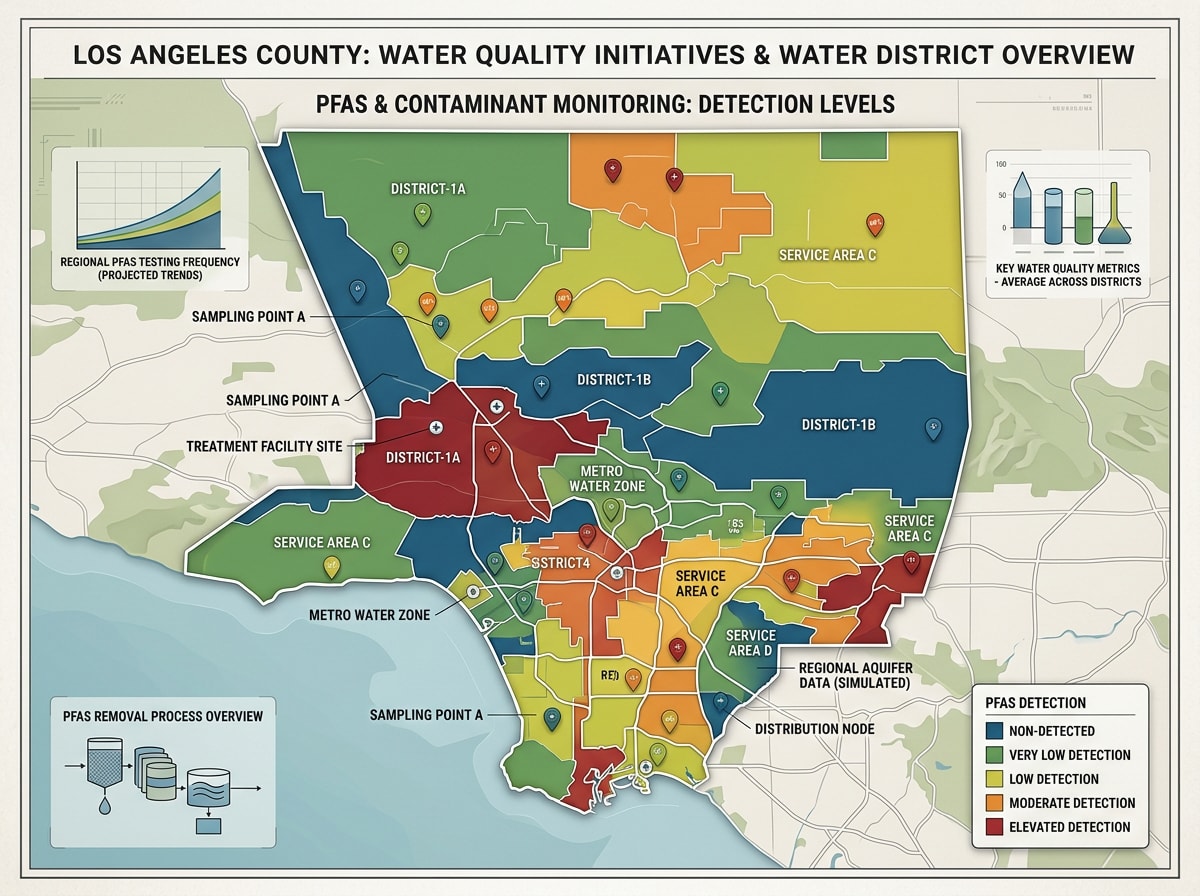
PFAS risk inside Los Angeles County isn't uniform, and that nuance matters for which filter you actually need:
- LADWP's service area blends imported surface water with groundwater, and the utility reports it has not detected the regulated PFAS compounds in distributed tap water.
- Central Basin groundwater near the Montebello Forebay is a different story. The Water Replenishment District has found PFOA and PFOS above Maximum Contaminant Levels in some production wells there, prompting a dedicated remediation program for the basin.
- LA County Waterworks Districts quarterly-monitor wells near airports, landfills, and other known PFAS sources, and most of those wells have come back clear so far.
That patchwork is exactly why a single countywide answer ("just buy an RO system") is close, but not complete, without knowing which provider serves your address.
What Else Is in Los Angeles County Tap Water?
PFAS is one issue among several. County supply blends Colorado River water, State Water Project deliveries, and local groundwater, and each source brings its own baggage.
Chloramine, the secondary disinfectant most LA County utilities use, produces a faint chemical taste and is the most common reason households add carbon filtration in the first place. Chromium-6, present in some San Fernando and San Gabriel Valley groundwater, still has no federal enforceable limit, which is why many residents filter it further at home. Water hardness also swings noticeably by city, which affects soap performance and shortens appliance life over time.
Stack PFAS on top of that mix, and a single-contaminant mindset stops making sense. You can see which contaminants actually show up for your own provider through contaminant detection testing rather than guessing from county-wide averages. For a broader rundown of what's changed in local water chemistry heading into 2026, our water treatment technologies guide for Los Angeles County covers it in more depth.
Best Filtration Systems for Removing PFAS in Los Angeles County
Homeowners researching this topic usually land on four real options: under-sink reverse osmosis, whole-house catalytic carbon/resin systems, budget carbon-block filters, and countertop RO for renters. Each handles PFAS differently.
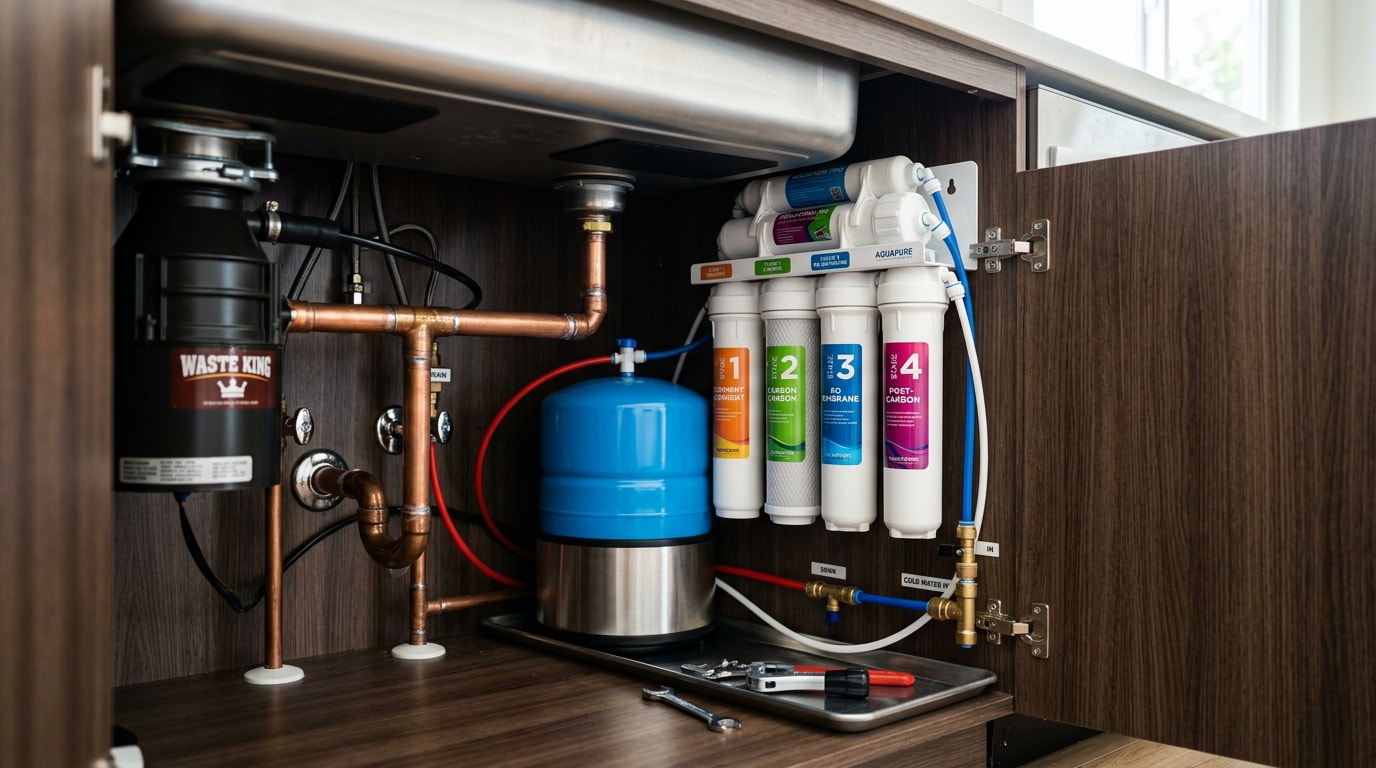
Best Overall: Reverse Osmosis Under the Kitchen Sink
Certified reverse osmosis is the gold standard for residential PFAS removal. The relevant certifications are NSF/ANSI 58 for RO systems and NSF/ANSI 53 for carbon and anion-exchange filters, both of which now carry PFOA/PFOS and Total PFAS reduction claims directly, through NSF International's PFAS certification program.
One correction worth making here, because a lot of local filter pages still get it wrong: the old standalone "P473" PFAS protocol was folded into NSF/ANSI 53 and 58 between 2018 and 2022, with the current standard covering PFHxS, PFNA, PFHpA, PFBS, and PFDA in addition to PFOA/PFOS. If a product page still advertises "P473 certified" as a separate badge, ask for the current NSF/ANSI 53 or 58 listing instead.
Not all under-sink RO systems perform the same. Compare specs rather than shopping on price alone:
| System Tier | Certification | PFAS Reduction | Install Type | Typical Install Cost |
|---|---|---|---|---|
| Entry-level 3-stage RO | NSF/ANSI 58 | ~95-97% | Standard, with storage tank | $300-$500 |
| Tankless RO | NSF/ANSI 58, Total PFAS claim | ~98-99% | Compact, no storage tank | $600-$900 |
| High-capacity multi-stage RO | NSF/ANSI 58, Total PFAS claim | 99%+ | Standard, higher GPD rating | $800-$1,200 |
Tankless RO has gotten popular in LA County homes with shallow under-sink cabinets, since it skips the bulky storage tank without sacrificing PFOA/PFOS removal. Whichever tier you pick, confirm the certification sticker specifically lists a PFOA/PFOS or Total PFAS claim. Plenty of RO systems only carry sediment and taste certifications. Browse our reverse osmosis systems to compare current models.
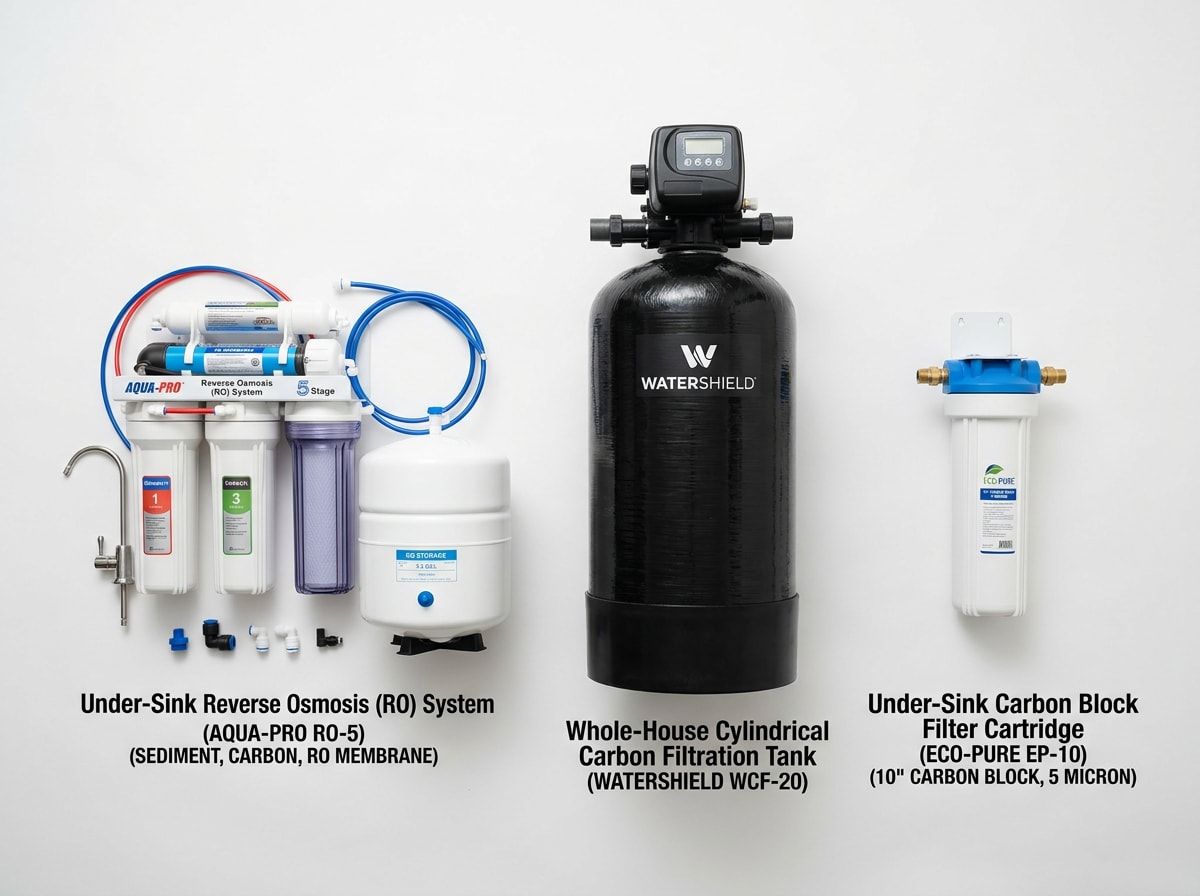
Best Whole-House Option: Catalytic Carbon + PFAS Anion Resin
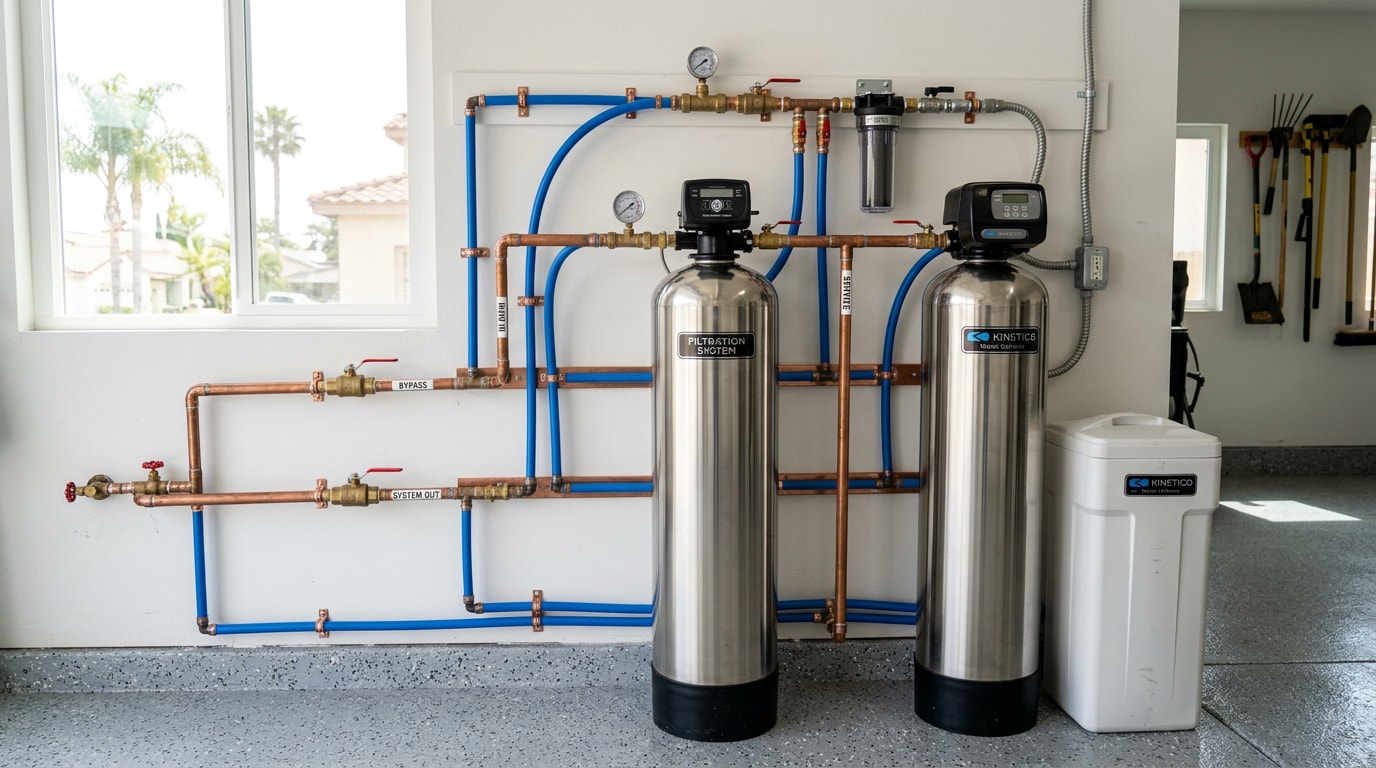
Whole-house systems treat water at the point of entry, so every faucet, shower, and washing machine gets PFAS-reduced water, not just the kitchen tap. These pair a catalytic carbon tank with a dedicated PFAS-selective anion resin tank, and manufacturers report total PFAS reduction near 99% when both stages are sized to household flow.
This setup suits families concerned about PFAS exposure through skin contact or inhalation during showers, not just drinking water. It's a bigger upfront investment than an under-sink unit and needs garage or utility space, but it removes the need for separate filters at every fixture.
Maintenance means periodic resin and carbon media replacement, typically every few years depending on usage and incoming contaminant load. A whole-house water filtration system is worth it if PFAS-reduced water at every tap matters more to you than minimizing install cost.
Best Budget Option: Under-Sink Carbon Block Filter
Under-sink carbon block filters are the cheapest entry point, often under $150 installed, and they handle chloramine taste, VOCs, and some heavy metals well. But budget carbon isn't automatically a PFAS solution.
Standard carbon block reduces PFAS inconsistently unless it's specifically rated under NSF 53 for PFOA/PFOS or Total PFAS. Many filters marketed for "better tasting water" were never tested against PFAS at all. If the budget is tight and PFAS removal matters, look for a catalytic carbon block with a documented PFAS certification rather than assuming any carbon filter will do the job. Read the certification sheet, not the marketing copy.
Best for Renters: Countertop Reverse Osmosis
If you can't modify plumbing, countertop RO is the practical answer. These units connect to an existing faucet, need no installation, and still deliver the same NSF/ANSI 58 PFAS reduction as an under-sink system. They move with you when the lease ends, which matters in a county where a large share of households rent.
Why Choose a Local Los Angeles County Water Filtration Provider
Picking the right technology only solves half the problem. Installation and ongoing verification matter just as much. A qualified local installer should show you the third-party NSF/ANSI certification for the exact unit they're installing, not a general product brochure.
Local expertise matters more here than in a lot of markets, given how much the contaminant mix shifts between imported Colorado River water, State Water Project supply, and local groundwater basins. In our service calls across the San Gabriel Valley and Santa Clarita, the most common reason a homeowner calls us back is an undersized carbon stage that was never matched to their actual flow rate or contaminant load, not a bad membrane.
Professional installation protects your plumbing warranty and keeps the system performing at its certified PFAS reduction rate over time. See our Los Angeles County service area page, or get a free estimate to have someone look at your specific address before you buy anything.
How Much Does PFAS Water Filtration Cost in LA County?
Total cost depends on system type, household size, and whether you're treating one tap or the whole house.
| System Type | Equipment + Install | Annual Maintenance |
|---|---|---|
| Carbon block, under-sink | $100-$150 | $50-$80 |
| Entry RO, under-sink | $300-$500 | $75-$150 |
| Tankless/high-capacity RO | $600-$1,200 | $100-$200 |
| Countertop RO (renters) | $300-$500 | $75-$120 |
| Whole-house carbon + resin | $3,000-$7,000+ | $300-$600 |
These are typical regional ranges, not quotes. Home size, water pressure, and existing plumbing access all move the number. The only way to get an accurate figure for your house is a site visit, which is also when a tech can tell you whether your current water even needs PFAS-specific treatment in the first place. If you're unsure where to start, water quality testing is cheaper than buying the wrong filter.
If you're comparing options across the region, our guide to water filter services in Ventura County is a useful reference point for how pricing and contamination profiles differ just one county over.
Ready to move forward? Contact us for a free in-home water assessment before you commit to a system.
FAQ
What Water Filter Removes PFAS?
Certified reverse osmosis is the most reliable option, reducing PFOA and PFOS by up to 99% when it carries an NSF/ANSI 58 Total PFAS claim. NSF 53-rated carbon can support PFAS reduction as an added stage, but it shouldn't be relied on alone since carbon media performance varies widely by product.
Does Reverse Osmosis Remove PFAS?
Yes. Certified RO systems are designed to reduce PFOA and PFOS well below EPA's 4.0 ppt federal limit. Short-chain PFAS compounds can be somewhat harder to fully capture than long-chain PFOA and PFOS, so confirm your specific system's PFAS testing data before buying.
How Do PFAS Get Into Los Angeles County Water?
PFAS typically enters local water through industrial discharge, landfill leachate, and firefighting foam used at airports and military training sites. Stormwater runoff carries it into groundwater basins, and it can persist there for decades once it arrives. It doesn't affect every provider equally; it depends on proximity to those source types.
What's the Best PFAS Filter for LA County Renters?
Countertop reverse osmosis. It needs no plumbing modification, delivers the same certified PFAS reduction as an under-sink unit, and can move with you when you relocate.
Should I Test My Water for PFAS Before Buying a Filter?
Yes. PFAS exposure varies by provider and even by well within Los Angeles County, so a filter sized for a generic "LA County problem" can be the wrong fit. Water quality testing tells you what's actually in your water before you spend money.
Are There Microplastics in My Water Too?
Microplastics are a separate contaminant from PFAS, but the overlap is good news for filtration shoppers. RO membranes built for PFOA/PFOS removal are also fine enough to capture most microplastic particles during the same filtration pass.