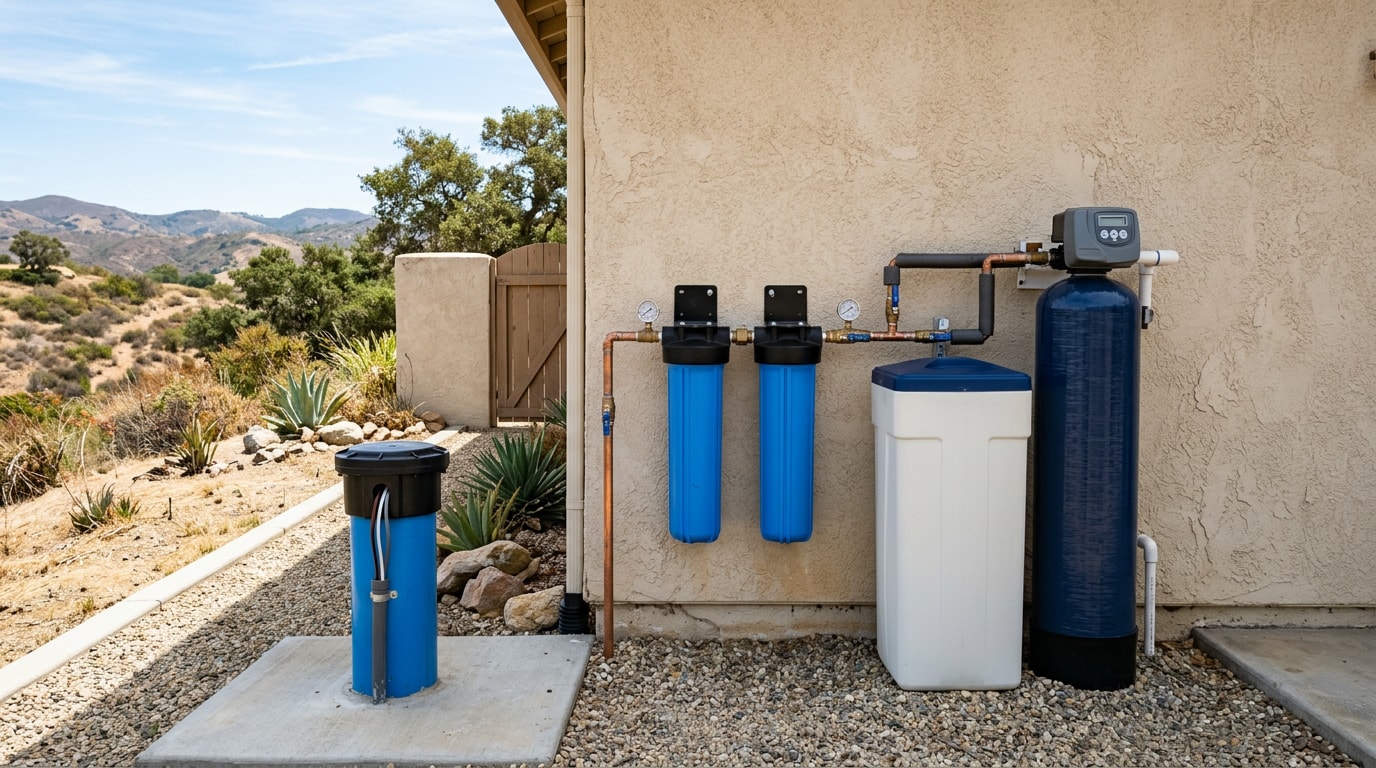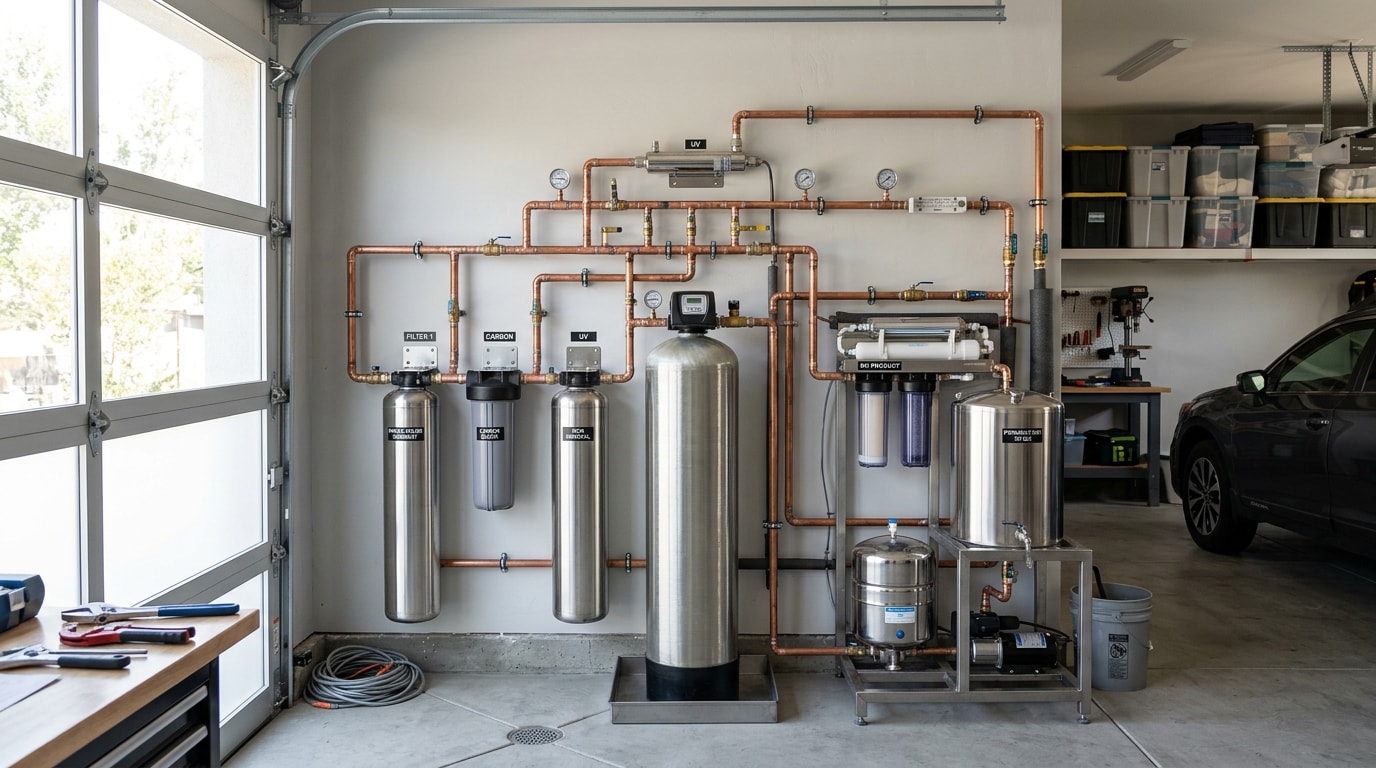
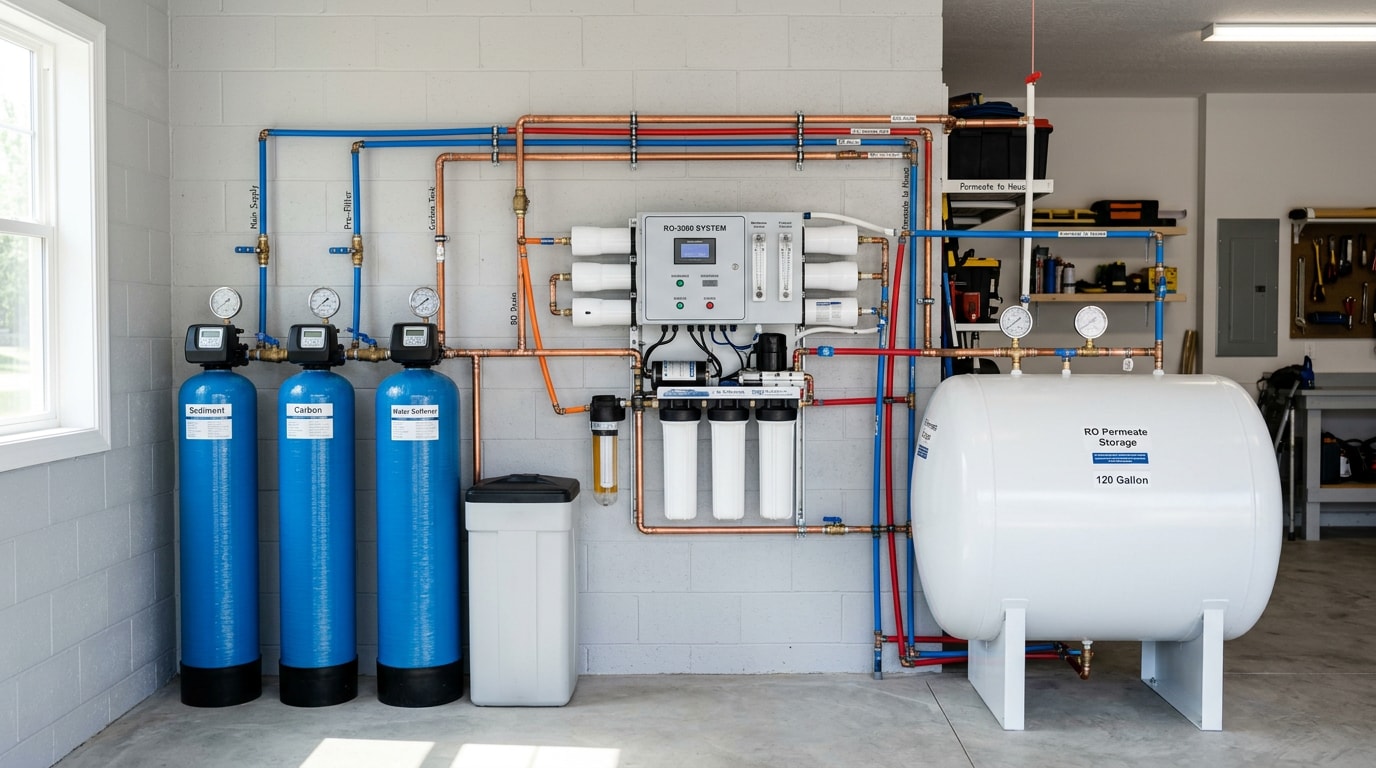
A whole house reverse osmosis water filtration system in Kern County, CA treats every tap in the home instead of just the kitchen sink, which matters when well water carries hardness, arsenic, and high TDS at the same time. Homeowners in Bakersfield, Oildale, Shafter, Arvin, and the surrounding valley usually start looking into whole-house RO after a water test flags a problem or scale buildup becomes impossible to ignore. Here's how the technology actually works, what local groundwater data shows, and how to size a system that fits your well or municipal supply.
What Is a Whole-House Reverse Osmosis System?
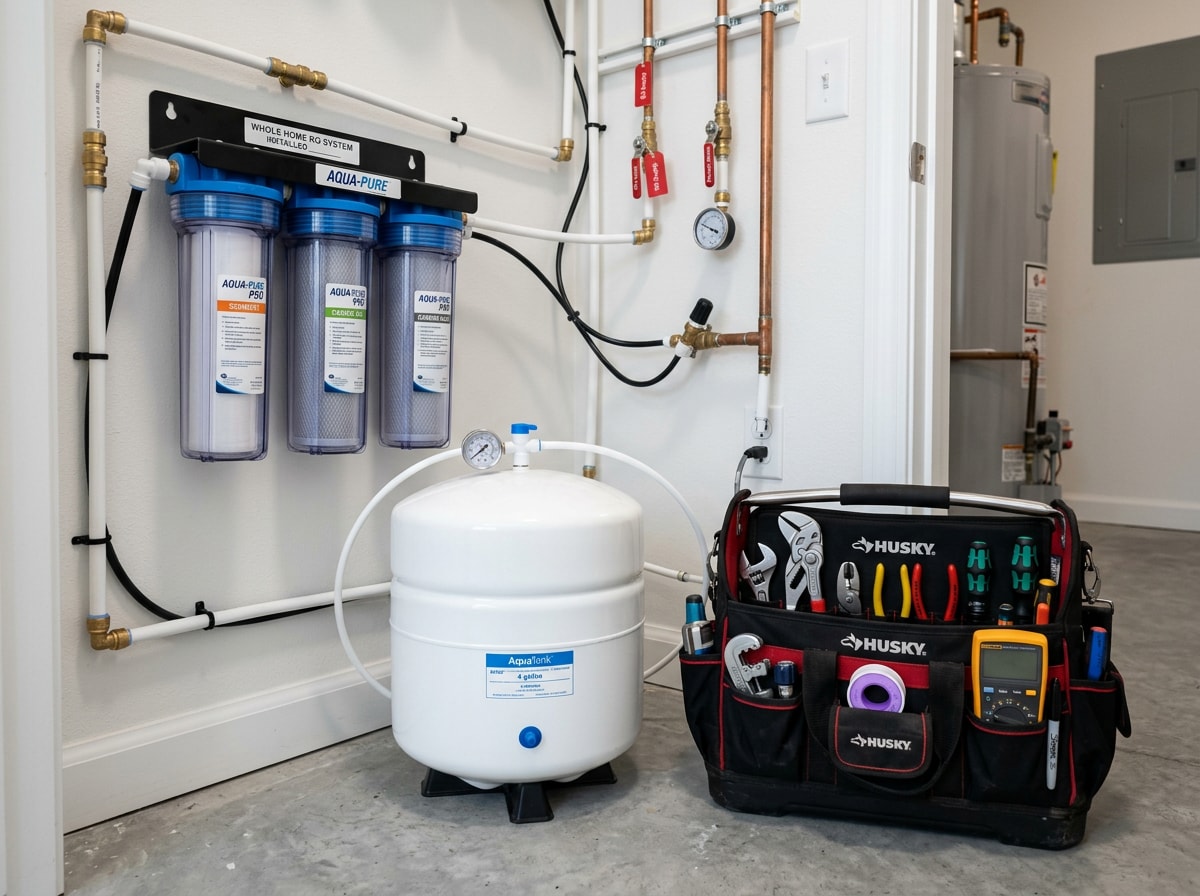
Reverse osmosis forces water through a semi-permeable membrane that blocks dissolved solids, metals, and contaminants too small for standard filters to catch. A point-of-use RO unit does this at one faucet, usually under the kitchen sink. A whole-house, or point-of-entry, configuration treats water as it enters the home so every fixture, from the shower to the washing machine, gets the same treated supply.
The EPA draws the same line in its guidance for homeowners: a point-of-entry system is installed to treat water at the point it enters the building and distributes treated water throughout for all uses, since these devices treat large quantities of water and are best suited for situations where the source poses consistent, significant contamination challenges .
That distinction drives cost and complexity. Whole-house RO needs higher output, a pressurized storage tank, and pretreatment stages to protect the membrane, while a single under-sink unit does not.
Whole-House RO vs. Point-of-Use RO
| Factor | Point-of-Use RO | Whole-House RO |
|---|---|---|
| Where it treats water | One tap, usually the kitchen | Main line, every fixture in the home |
| Typical output | 50-100 gallons per day | 1,000+ gallons per day |
| Extra hardware needed | Small undercounter tank | Large storage tank, booster pump, shutoff switch |
| Remineralization | Rarely required | Often added to protect copper and lead plumbing |
| Best fit | Drinking and cooking water only | Contamination affecting every tap, not just one |
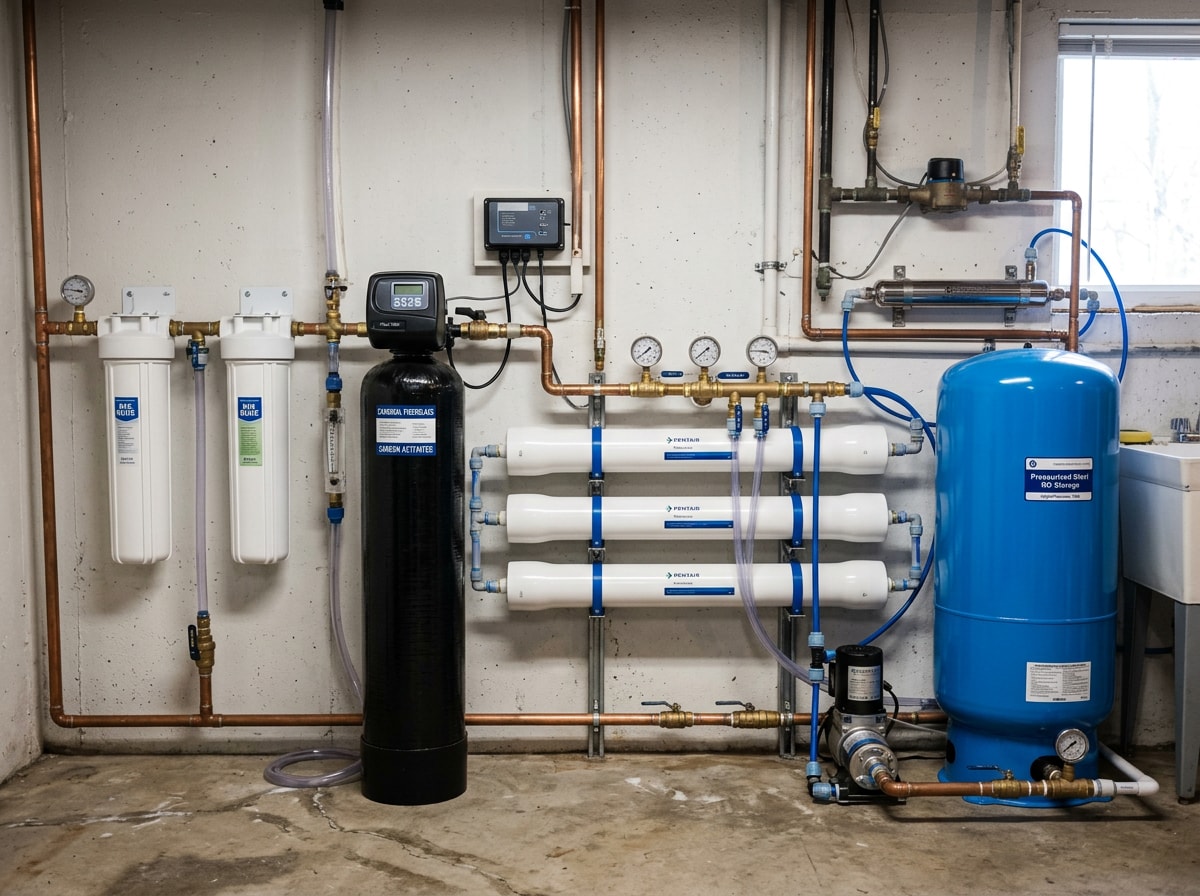
EPA researchers studying point-of-entry RO found that treating water for the entire home requires additional components such as a 200-500-gallon water storage tank, a 20-gallon bladder tank, and a pump with a shutoff switch, and because RO demineralizes water, homeowners may need to add mineralization cartridges to prevent lead and copper corrosion in household plumbing . That's a real engineering tradeoff most buying guides skip over, and it's one reason whole-house RO costs more than people expect going in.
One certification detail worth knowing before you shop: NSF/ANSI 58 is the American National Standard for point-of-use (POU) reverse osmosis (RO) systems . It doesn't directly cover whole-house configurations, so a point-of-entry RO system should be evaluated on its full build, tank sizing, and pretreatment, not just a membrane's certification sticker.
Why Kern County Water Often Needs More Than a Basic Filter
Kern County's groundwater sits on old sedimentary deposits, and that geology shows up in well-water test results across the valley. USGS researchers studying the Kern County subbasin found that old, crustal fluids contain higher concentrations of arsenic, TDS, and methane in the domestic resources in the Kern County subbasin , which explains why wells drawing from deeper or older groundwater tend to run higher in both minerals and TDS than newer recharge water.
Arsenic isn't rare in the region, either. Across the broader San Joaquin Valley, which includes the Kern subbasin, about 10% of drinking water wells since 2010 had arsenic concentrations above the US maximum contaminant level of 10 μg/L . Most of that arsenic occurs naturally rather than from contamination, but it's still a federal health limit and worth testing for before deciding on equipment.
Nitrates show up too, mostly tied to agricultural land use rather than geology. Between hardness, arsenic, high TDS, and nitrate risk in farming areas, it's common for one well to have two or three of these issues layered on top of each other. That's the scenario where a single carbon filter stops being enough, and where whole-house reverse osmosis installation starts making more sense than treating one tap at a time.
In our own testing visits across Bakersfield, Oildale, and the outlying well-dependent areas, it's common to see elevated TDS readings alongside measurable arsenic on the same water sample, which is exactly the combination whole-house RO is built to handle.
Does Every Kern County Home Need Whole-House RO?
Not necessarily. Whole-house RO is the right call for dissolved contaminants affecting every tap, not for hardness alone.
- Sediment filtration handles grit, sand, and particulates from well water.
- Dedicated media filters target iron and manganese staining before it reaches fixtures.
- Water softening resolves hardness and scale without touching TDS or arsenic.
- Whole-house RO steps in when dissolved solids, arsenic, or nitrates run high across the entire supply.
A common setup pairs a water softening system with sediment and carbon stages for general household use, then adds point-of-use or whole-house RO for the contaminants softening alone can't remove. Homes on private wells often need this layered approach more than homes on treated municipal supply; our well water treatment page walks through how that pairing gets sized. For a closer look at sizing a softener against Kern County's groundwater first, our Water Softener Near Me Kern County, CA buyer's guide covers that step in detail.
What a Whole-House RO System Costs in Kern County
Costs vary with household size, well chemistry, and how much pretreatment the membrane needs to stay protected. The EPA's consumer guidance gives a useful baseline: distillation and RO systems tend to cost a few hundred dollars for point-of-use models and may require professional installation, while point-of-entry systems can cost thousands of dollars and generally require professional installation .
Whole-house configurations land at the higher end of that range because the pump, storage tank, and multi-stage pretreatment all scale up with the output needed to serve an entire home. A water test is the only reliable way to know which tier of equipment your property actually needs, since undersized pretreatment just means replacing a fouled membrane sooner.
How to Figure Out What Your Home Actually Needs
- Test the water first. Hardness, TDS, arsenic, and nitrates all point toward different equipment.
- Match pretreatment to what the test finds. Sediment and iron need to be handled before water reaches an RO membrane.
- Size the storage tank and pump to household demand. Undersizing is the most common reason whole-house RO disappoints people.
- Decide if softening needs to run alongside RO. Hardness and dissolved solids are different problems with different fixes.
Get a free estimate once you have test results in hand, so the system gets sized around your actual numbers instead of a generic recommendation. A proper water quality test checks all four factors above, and contaminant detection testing flags arsenic, nitrates, and other dissolved solids specifically before any equipment gets quoted.
Serving Kern County Homes and Wells
We work with properties throughout Bakersfield, Oildale, Shafter, Lamont, Arvin, and the surrounding Kern County, CA area. Well conditions and municipal supply quality vary block by block here, so every installation plan is built around that property's own test results rather than a one-size-fits-all package. You can also browse reverse osmosis systems and whole-house filtration systems for the full range of equipment we install, or start from the homepage to see everything we cover.
This guide was reviewed by our Kern County water treatment team at Pure Water Filtration, who size and install whole-house RO and softening systems on local wells and municipal connections throughout the county. Questions about a specific property can go straight to our contact page.
FAQ
How much does a whole house reverse osmosis system cost in Kern County?
Point-of-use RO units typically run a few hundred dollars installed. Whole-house configurations cost more, generally into the thousands, because the pump, storage tank, and pretreatment stages all scale up to treat every fixture in the home rather than one faucet.
Is whole house reverse osmosis worth it for Kern County homes?
It depends on what's in the water. Whole-house RO makes the most sense when dissolved contaminants like high TDS, arsenic, or nitrates show up across every tap. For hardness alone, a water softener paired with sediment and carbon filtration usually solves the problem without the added cost of whole-house RO.
Does reverse osmosis remove arsenic from well water?
Reverse osmosis membranes reduce arsenic along with other dissolved solids, which matters in Kern County given how often it shows up naturally in older groundwater. A water test confirms arsenic levels before sizing equipment, since treatment needs differ by concentration and well depth.
Do I need a water softener if I install whole-house RO?
Not always, but many Kern County homes pair the two. RO handles dissolved contaminants; softening handles hardness and scale. Running both together is common on wells that show high hardness and elevated TDS on the same test.
How is whole-house RO different from a standard whole-house water filter?
A standard whole-house filter typically uses sediment and carbon media to remove grit, chlorine, and some organic compounds. Reverse osmosis adds a membrane stage that reduces dissolved solids, arsenic, and nitrates at a molecular level, which sediment and carbon filters can't touch on their own.
What water quality issues are most common in Kern County?
Hardness, elevated TDS, naturally occurring arsenic in groundwater, and nitrates in agricultural areas are the issues that show up most often across Kern County wells and municipal sources, with the exact combination varying by location.